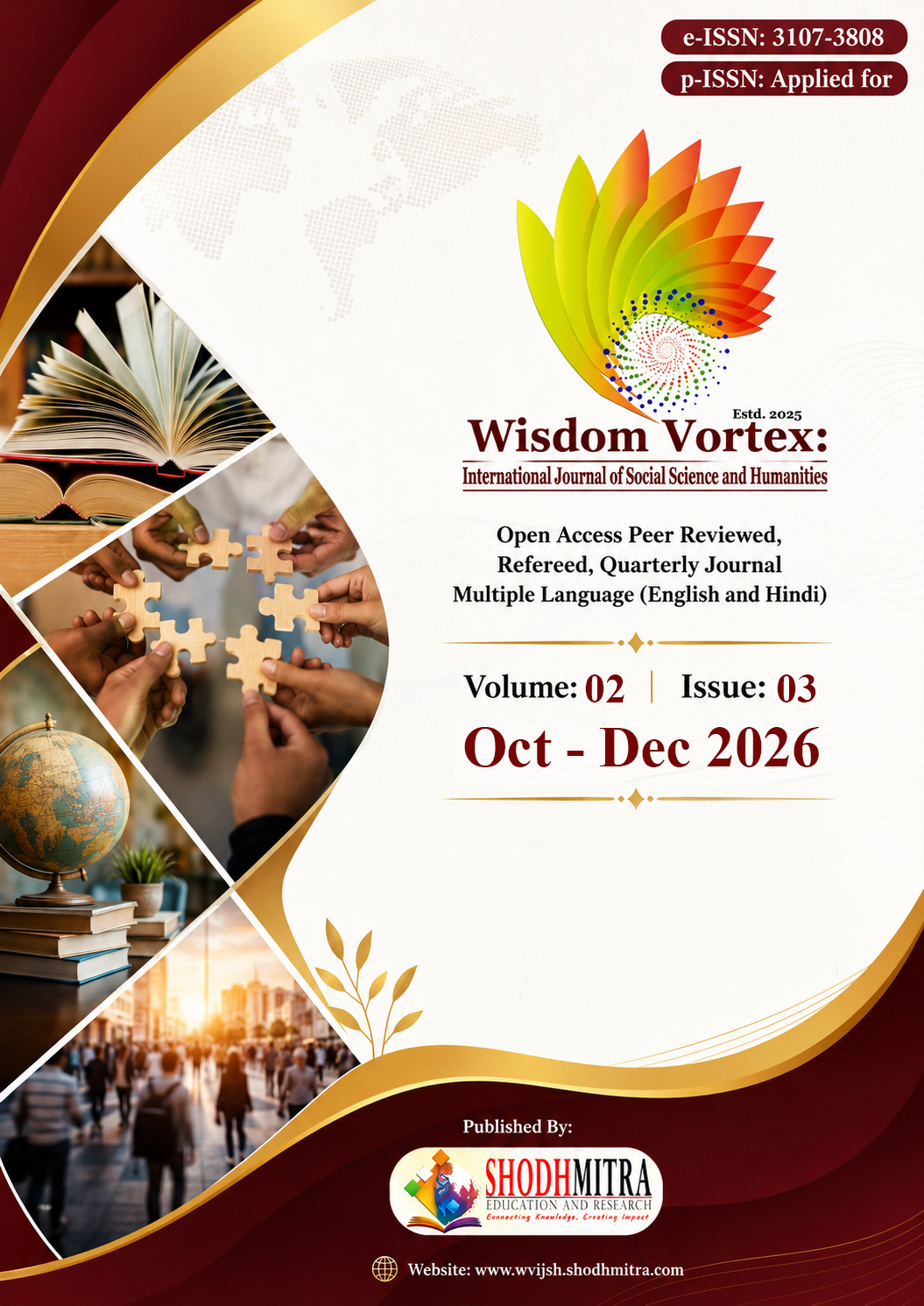
Inflation Dynamics, Monetary Policy Transmission, and Its Impact on Household Savings and Consumption
DOI:
https://doi.org/10.64429/wvijsh.02.03.054Keywords:
Monetary Policy Transmission, Inflation Dynamics, Household Savings, Consumption Expenditure, Asymmetric Pass-Through, Inflation TaxAbstract
This research investigates the interactions between monetary policy transmission, inflation persistence, household savings behavior, and private consumption in emerging market economies, focusing on India's Flexible Inflation Targeting (FIT) regime. While central banks strive to stabilize price volatility and maintain credit flows, structural rigidities and asymmetric monetary transmission, particularly slower commercial bank deposit rate adjustments compared to lending rates, impair policy pass-through and distort household financial incentives. Persistent inflationary shocks act as a regressive inflation tax, eroding real purchasing power and prompting precautionary portfolio rebalancing. When nominal deposit returns lag behind inflation, consumers shift savings from formal financial instruments into traditional inflation hedges like gold and residential real estate. While protecting individual wealth, this defensive reallocation starves the formal financial system of domestic capital and dampens long-term productive investment. Using an econometric design combining Autoregressive Distributed Lag (ARDL) cointegration and Structural Vector Autoregression (SVAR) analyses, this study maps short-run elasticities and long-run equilibria. The findings highlight the need for enhanced regulatory oversight of bank pricing mechanisms, improved inflation-indexed financial instruments, and robust fiscal-monetary coordination to protect consumer balance sheets and foster resilient, inclusive economic growth.
Downloads
Published
Issue
Section
License
Copyright (c) 2026 Rituja Bhattacharya (Author)

This work is licensed under a Creative Commons Attribution 4.0 International License.
Authors publishing in Wisdom Vortex: International Journal of Social Science and Humanities retain full copyright and grant the journal a non-exclusive license to publish, distribute, and archive their work in print and electronic formats. Authors may share or reuse their work with proper citation to the original publication in this journal.
All works are licensed under the Creative Commons Attribution 4.0 International License (CC BY 4.0), allowing sharing, adaptation, and commercial use with proper attribution. Full copyright and licensing terms are available at Policies section.